Source file: docs/models/gym80-lat-pulldown-machine.md · rendered from the repository
gym80 3020 Lat Pulldown Machine (Sygnum)
Status: Parametric – formula ready, inputs must be measured
Confidence of outputs: estimated · method: mechanical-model · built: 2026-10-17
Mechanism: pulley / cam ratio model (stack weight × cable ratio, plus pulley friction)
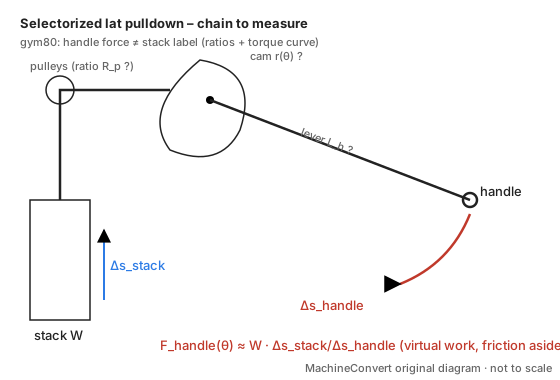
Model
F_handle(θ) = W · R(θ) · η^n with R(θ) = Δs_stack / Δs_handle measured at start / mid / end
Why no full numeric estimate: gym80 publishes no ratios, cam profiles or dimension drawings (product sheet and 2025 instructions for use checked); the spare-parts brochure lists fixed pulley diameters, but fixed pulley diameters do not change the ratio.
Inputs
| Symbol | Input | Value | Status | Uncertainty | Source (verbatim quote) |
|---|---|---|---|---|---|
| W | Selected stack label | — | ⚙️ user setting | — | manufacturer_page: “Standard weight-stack: 135 (optional 165) kg” · retrieved 2026-10-17 |
| label accuracy | Stack labels are not calibrated Note: gym80 itself says handle force ≠ stack label because of machine-specific ratios and the built-in torque curve (cam). |
— | ✅ sourced | — | manufacturer_manual p. 4.1: “KG-Angaben: Die aufgedruckten KG-Angaben auf den Steckgewichten sind Anhaltswerte und nicht geeicht. Die auf den Patienten wirkende Kraft bzw. Drehmomente sind durch Gerätespezifische Über- und Untersetzungen bzw. durch die integrierte Drehmomentkurve der Geräte nicht identisch und stimmen nicht mit den KG Angaben an den Steckgewichten überein.” — (our translation) "The kg figures printed on the stack plates are guide values and not calibrated. The force or torque acting on the user is, because of machine-specific gear-up/gear-down ratios or the integrated torque curve, not identical to and does not match the kg figures on the stack plates." · retrieved 2026-10-17 |
| R(θ) | Overall ratio (pulleys × cam × lever) at start/mid/end How to measure: Move the handle in 5 cm steps around each ROM point; measure the stack rise each time. R = Δstack / Δhandle (measure along the handle path). |
— | 📏 to measure (Maxime) | — | — |
| n, η | Pulleys and their efficiency | — | 📏 to measure (Maxime) | [0.96 … 1.0] — crane-sheave table | engineering_reference: “Ratio A Bronze Brushed Sheaves | Ratio B Anti-Friction Bearing Sheaves | Number of Line Parts … .96 | .98 | 1” — Table header and first row (1 line part) · retrieved 2026-10-17 |
Validation by Maxime
Follow docs/protocole-mesure-fr.md. Geometry/ratio to measure: R(θ), n, η. Once measured, the inputs are entered and the curve is computed with the same code (research/models/build_models.py).