Source file: docs/models/hammer-strength-hammer-strength-select-lat-pulldown.md · rendered from the repository
Hammer Strength Select Lat Pulldown (HS-PD)
Status: Parametric – formula ready, inputs must be measured
Confidence of outputs: estimated · method: mechanical-model · built: 2026-10-17
Mechanism: pulley / cam ratio model (stack weight × cable ratio, plus pulley friction)
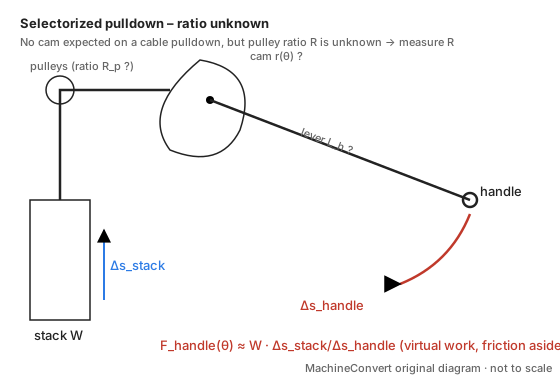
Model
T_clip = W · R · η^n with R = Δs_stack / Δs_handle (virtual work)
Why no full numeric estimate: Pulley ratio R is not published by Hammer Strength / Life Fitness and the manual shows no routing.
Inputs
| Symbol | Input | Value | Status | Uncertainty | Source (verbatim quote) |
|---|---|---|---|---|---|
| W | Selected stack label Note: Stack range sourced (295 lb / 138 kg); plate increments not stated in the manual. |
— | ⚙️ user setting | — | manufacturer_manual p. 31 of 73: “Product Code: HS-PD … Weight Stack: 295 lbs. 138 kg” · retrieved 2026-10-17 |
| R | Cable ratio stack travel / bar travel Note: The owner's manual (9510901 Rev BC) has no cable-routing diagram, so a movable (doubling) pulley cannot be excluded. How to measure: Pull the bar 30 cm, measure how far the top plate rises (tape on the guide rod). R = stack rise / bar travel. |
— | 📏 to measure (Maxime) | — | — |
| n | Number of pulleys the cable runs over How to measure: Count pulleys from the top plate to the clip (photo). |
— | 📏 to measure (Maxime) | — | — |
| η | Efficiency per pulley | — | ✅ sourced | [0.96 … 1.0] — crane-sheave table: 0.96 (bronze bushing) to 0.98 (anti-friction); 1.0 = ideal | engineering_reference: “Ratio A Bronze Brushed Sheaves | Ratio B Anti-Friction Bearing Sheaves | Number of Line Parts … .96 | .98 | 1” — Table header and first row (1 line part) · retrieved 2026-10-17 |
Validation by Maxime
Follow docs/protocole-mesure-fr.md. Geometry/ratio to measure: R, n. Once measured, the inputs are entered and the curve is computed with the same code (research/models/build_models.py).