Source file: docs/models/hammer-strength-plate-loaded-linear-leg-press.md · rendered from the repository
Hammer Strength Plate Loaded Linear Leg Press (HSLLP)
Status: Computed – numeric estimate available
Confidence of outputs: estimated · method: mechanical-model · built: 2026-10-17
Mechanism: incline sled model (starting resistance + plates × sine of the sled angle, plus rail friction)
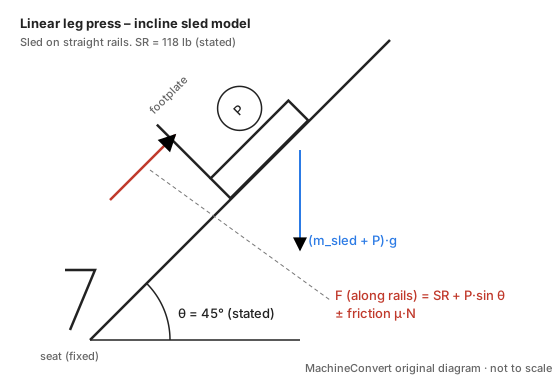
Model
F = SR + P·sin(θ) ± μ·(SR·cot θ + P·cos θ)
Inputs
| Symbol | Input | Value | Status | Uncertainty | Source (verbatim quote) |
|---|---|---|---|---|---|
| θ | Rail angle to horizontal Note: We assume "45-degree angle" is the sled travel direction vs. horizontal. How to measure: Phone inclinometer laid on a guide rod, 3 readings. |
45 deg | ✅ sourced | ± 1 — ASSUMPTION (not sourced): ±1° covers rounding of the stated "45-degree" and build tolerance; replace with Maxime's inclinometer reading | manufacturer_page: “Featuring a 45-degree angle, this machine provides a smooth, stable press” · retrieved 2026-10-17 |
| SR | Starting resistance (empty sled, at the footplate) Note: 118 lb = 53.52 kg; the page rounds to 53 kg. Life Fitness AU page says "118 lbs (53 kg) per arm" for the same single-sled machine. We assume SR is the along-rail force with no plates. How to measure: Crane scale + ratchet strap in series, sled empty (protocol §4). |
53.52 kg | ✅ sourced | ± 0.227 — rounding of the stated integer "118 lbs" (±0.5 lb) | manufacturer_page: “118 lbs (53 kg)” — Spec table row "Starting Resistance" · retrieved 2026-10-17 |
| μ | Rolling friction coefficient of the sled bearings Note: Friction raises the force while pushing up (concentric) and lowers it while lowering (eccentric). Static value lies in between. |
— | ✅ sourced | [0.001 … 0.01] — THK table 4: linear bushing (0.001) up to LM roller (0.01). Hammer only says "linear guide rods, equipped with sealed ball bearings" – exact bearing type unknown; seal drag not included. | engineering_reference: “Linear bushing LM, LMK, LMF, SC 0.001 to 0.003 … LM roller LR, LRA 0.005 to 0.01” · retrieved 2026-10-17 |
| P | Plate mass added (label value) Note: Plate labels are taken at face value; real plate mass tolerance is not modelled. |
— | ⚙️ user setting | — | — |
⚠️ Explicit assumptions (not sourced): uncertainty band of θ. They widen the error band; they do not move the nominal value.
Resulting handle-force curve
Same value at start, mid and end of the ROM (no cam/lever in this model). kgf = kilogram-force.
| Plates added (kg) | Nominal (static, kgf) | Low (lowering) | High (lifting) |
|---|---|---|---|
| 0 | 53.5 | 52.7 | 54.3 |
| 20 | 67.7 | 66.5 | 68.8 |
| 40 | 81.8 | 80.2 | 83.3 |
| 60 | 96.0 | 94.0 | 97.8 |
| 80 | 110.1 | 107.7 | 112.4 |
| 100 | 124.2 | 121.5 | 126.9 |
| 120 | 138.4 | 135.2 | 141.4 |
| 140 | 152.5 | 149.0 | 155.9 |
| 160 | 166.7 | 162.7 | 170.5 |
| 180 | 180.8 | 176.5 | 185.0 |
| 200 | 194.9 | 190.2 | 199.5 |
| 250 | 230.3 | 224.6 | 235.8 |
| 300 | 265.7 | 259.0 | 272.2 |
| 400 | 336.4 | 327.7 | 344.8 |
| 500 | 407.1 | 396.5 | 417.4 |
| 600 | 477.8 | 465.2 | 490.0 |
| 700 | 548.5 | 534.0 | 562.7 |
| 800 | 619.2 | 602.7 | 635.3 |
Error band = worst case over every input band (corner enumeration), friction applied against the motion.
Not modelled (known unknowns)
- Seal drag of the "sealed ball bearings" (not in THK figures)
- Real mass of the plates vs. their label
- Whether the manufacturer SR already includes friction
Validation by Maxime
Follow docs/protocole-mesure-fr.md. Then compare force-gauge readings with the table above: a reading outside the band means the model (or a source) is wrong.